Friday, July 27, 2007

زبان و آشنایی

شکرپاره ها


سه پاره است اگر


سه نام دارد اگـــر


زقند پارسیان تا زبان تاجیکان


زبان نغز دری
به کام من بخدا هر سه پاره شـــــــیرین است
سه پاره است ولی بیگمان ز یک شـکر است


اتاوا 25 جولای 2007
آصف فکرت
........................................


آشنایی

ندانم دلبر سعدی زکابل بود یا از بلخ
ولیکن بلبل دستانسرای عاشق شیراز
به هنجار دری از وی سخن گفتن همی آموخت *ـ
*
گرم رانند و گر بیگانه ام خوانند
مرا با شهریاران، شهرداران نیست پیوندی و پیمانی
ولی من آشنای دلبر شیرازی خویشم
چرا گویم زبانش را نمی دانم
پیامش را نمی خوانم
گرفتم آنکه آسان در نیابم من زبانش را
ولی باشد مرا فرّی ز فرهنگی
که گوید "همدلی از همزبانی خوشتراست" ای دوست!ـ

اتاوا 27 جولای 2007آصف فکرت..............................................
: سعدی فرماید*
هزار بلبل دســـــتانسرای عاشق را
بباید از تو سخن گفتن دری آموخت

Friday, March 30, 2007

Wisdom


On old days, I heard these very thoughtful Persian verses from one of my literature teachers whose name I can not recall now. God bless him and God bless the poet who wrote this piece of wisdom and literature. Here I translate it for you. Asef Fekrat


Knowledge

One who knows and knows that he knows,
He will drive the chariot of honor above the skies.
One who knows and does not know that he knows,
Awaken him; let him not remain ignorant.
One who does not know and knows that he does not know
He also will drive his lame donkey to the village
One who does not know and does not know that he does not know
He well remain in double ignorance, forever.

Saturday, March 03, 2007

Selected Verses from Persian Poets

Here are some Persian verses, selected and translated, for you, by Asef Fekrat.
This selection will be continued
:

Flame

We are flames,
Clad in black from the smoke of our heart
Burning silently, like a tulip

(Asef Qommi)

Empty

Excited of your beauty
I am fallen, senseless
Like an empty bottle of wine

(Aahi Herawi)

Hurry

I hurried in expressing my love
Made her upset
Love requires patience
My heart was restless

(Ibrahim Shirin Ojaq)

Breeze and tress of hair
Breeze gifted a flower smell to his collar
Her tress of hair caught it
Threw it away

(Bismil Sistani)

Wine and flower

Your beauty garden, flourished from wine
The flower on your hair
Looks like a drunk nightingale
(ibid)

Saturday, February 03, 2007

An Ode by Rumi

All Night

I was searching for something in Rumi’s poems, when I encountered this ode. So I translated it for you: Asef Fekrat

Where is the beauty that I saw on your face all night?
And sugar-like words that I heard from you, all night
Even though my heart was burning of your face
I flew around the candle of your face all night
The night before your moonlike face, was fixing tent
I was tearing the tent on the night like the moon, all night
The soul, like a cat, was licking its lips, desiring you
And I, like babies, was licking the tip of my finger, all night
My chest was crowded like the nest of bees
Since I was getting honey from you, o spring of honey! All night
The trap of the night came and took the souls of the peoples
I was palpitating, in that trap, like the heart of a bird, all night
To whom all souls are subdued like pigeons
In that trap, I was searching him, all night

Saturday, November 11, 2006

Four short poems

By Asef Fekrat
(original in Persian)


Last Scene

A faded autumn leaf
With all its existence
Stuck on the ground
So, even at the last moment,
Have had left a memory
from its beauty

Weeping

Lightning, rain, and breeze
Came together
Which lover
Has reminded weeping
At your skirt


You..?

Today, breeze blows tended
The dawn bird has awaken earlier
Passengers look more kindly to each other
-
Have you passed by, last night, here?


Thinking of you

Nice and pleasant
Like the smell of a red rose
To think of you
--
I am thinking now

Asef Fekrat

Wednesday, November 08, 2006

A Story


Morning Glory


It is a summer Saturday, and I am walking back home from library. Today, as previous days, I change my way and choose a new street. I am new in Ottawa, and I want to know my neighborhood and my new city better. I expect to see new things, as I have already seen. Saturday is silent and solitude. As I walk, I watch the flowerbeds at front of houses. There are many flowers, which I know. However, many are new to me, or, in my hometown, we know them as wild flowers. Suddenly, I stop. There is Morning Glory, my favorite flower. I love it for many reasons. I love it from my childhood. I like its heart shaped leaves. I like its different colors. I like it because it makes mornings more beautiful. It changes the light of the sun in a lovely manner. It spirals around any subject that is near to it as if it has fallen in love with it. It is why in my hometown they call it “love spiraled.” I love Morning Glory because it reminds my childhood lovely days. My mother liked this flower and always planted its seed and I watched its growth since it was a seed until it became a spiraled lovely plant full of flowers. Therefore, it is my mother’s flower, and there is no doubt that I love it. I stand and watch it carefully and lovingly. From a far distance, a senior lady is walking to my side. I continue looking at flowers as well as at old buildings, which have a lovely style. It is getting late. I resume walking. I feel my necktie moved on one side because I have worn a thin slippery shirt that cannot hold the tie. I need a mirror to fix my tie. I reach to a parked car, and I look at its window’s mirror to fix my tie. The woman is very near to me. She has a meaningful look at me and claps her hands together. I resume walking. All neighborhoods’ dogs bark. I am happy, and the lady is happy too. I am happy because I have found another thing that links Ottawa to my childhood hometown; the lady is happy of thinking that she has saved others’ property. Everyday I learn a new lesson in my new hometown.

October 9, 2006

Asef Fekrat

Saturday, October 21, 2006

Khorasanian Mystic and Poetry

Aboo Sa’id Abulkhair great mystic of Khorasan (370 – 440 AH/ 992-1062 AD ) was sitting with his followers, while one of them was citing Persian poem. The man cited this verse aloud:
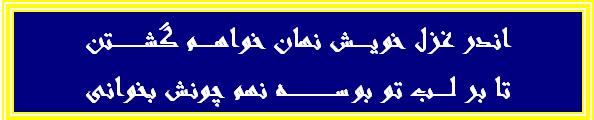
I will hide inside my words
To kiss your lips
When you read my ode

Aboo Sa’id was excited and asked whose poem was? The man said: Emara Marwzi was the poet. Emara”s tomb was in Mahana, where Aboo Sa’id lived. Aboo Sa’id said: God bless Emara. He rose, asking his followers: Let us go to Emara’s tomb for a pilgrimage.
This is the Emara’s Persian verse:


Thursday, October 19, 2006

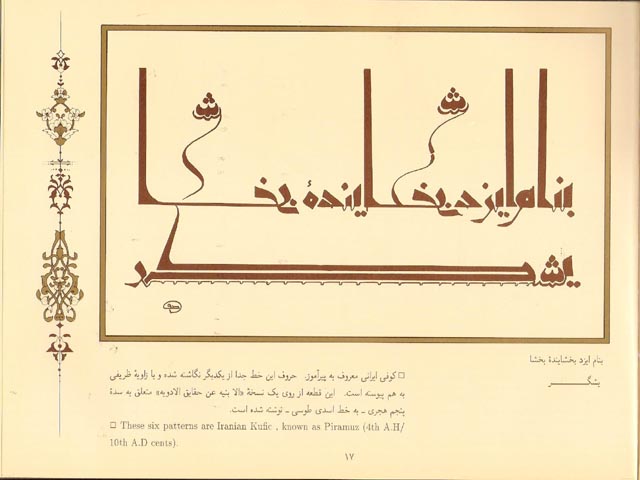
PIRAMOOZ


A beautiful script, Piramooz, that was famous and favourite in Khorasan about 1000 years ago. This pattern is written by Asef Fekrat based on the ancient manuscripts, preserved in Astan-Quds Library in Mashad, Iran

Wednesday, October 11, 2006

Kufic script


I wrote this calligraphic pattern, based on a manuscript from 5th AH/ 11th AD century. I was studying and watching the manuscript for many days, and still I liked to look at different aspects of its artistic characteristics. The original manuscript was written in Khurasan. One can imagine how fantastic the original work is.

Kufic Script


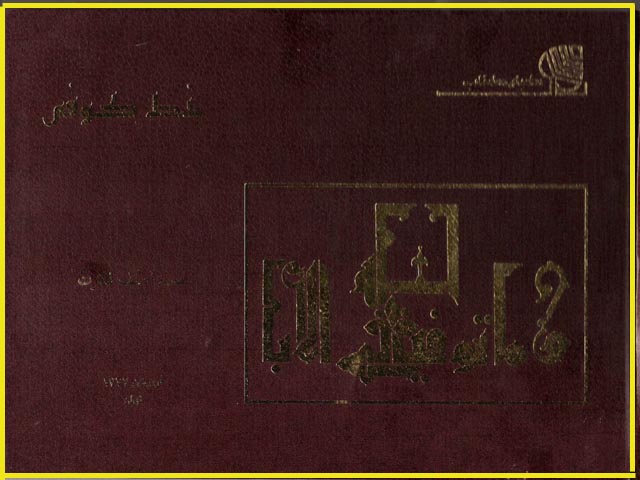
salwaat, another calligraphic work by Asef Fekrat, from his book, Kufic Script, published by Kian-Ketab, Tehran, 1998.

KUFIC SCRIPT


AUthor: Asef Fekrat
Publisher: Kian Ketab
Tehran, Iran, 1998


Introduction:Kufic Script is directly derived from Hijazi Script, whose origin may in order be traced to Hirian, Nebtian, Anbarian, and etc.
Here we do not intend to examine the different views about the exact source and origin of the Kufic Script, and find the integrity of our investigation concerning this subject, which has hitherto been studied by many competent researchers. An analytic-descriptive definition of Kufic Script will be explained as an introduction to theme propounded in this work.
The available petrographs and existing documents, which belong to the first century (AH), indicates that in different kinds irregular arabesque writing Naskh and Kufic scripts have been carelessly used, and no rule or method was officially proposed to follow.


The objective has only been restricted to recording of the written materials and their concepts without paying attention to the elegance and artistic issues, which would have enriched those handwritings.
Such samples can be found in some available inscriptions on stones and in a few documents as well. But when calligraphy was employed in the service of the religion of Islam for the purpose of writing and recording holy Qur’anic verses, it entirely got changed and gradually paced at the path of perfection from viewpoint and aspect of art and elegance.
The first style of the Islamic writing in which the manifestation of art, delicacy and beauty are explicitly evident, is that of Kufic Script. As this very handwriting is said to have been developed in the city of Kufa, so it is called Kufic. The invention or innovation of this script has been ascribed to His Holiness Ali( A.S.).

During the first three centuries(A.H.), the Glorious Qu’ran was practically written and recorded with Kufic Script, while calligraphers of every land used to use there personal style and taste in this sort of handwriting. The nibs of their pens might have been different from one another, or tendency of vertical ribs of the letters towards left and right sides together with some other invented differences exerted in the chosen letters might have characterized the style and place of writing. Thus, various ways of inscribing letters like those of Kufic, Madani, Basri, Shami( Syrian), and Maghrebi scripts came to existence.
In spite of these differences so long as using the Kufic Script uses practically restricted to the Arabian Peninsula, no significant changes appeared in the original forms of this handwriting.
In fact Kufic Script can be known as the first and earliest calligraphy used in writing many copies of the Glorious Qur’an, which are still found here and there in every part of today’s world.
“E’rab” and “E’jam” ( sounds and point of vowels):
The early Kufic Script did not have any signs to display the correct pronunciation of words. Even dots were not used on or under the letters. However, in the course of time, signs for pronouncing vowels gradually appeared. Abul-Aswad- Doeli (688 AD) has been known as the first scribe who used such signs.


In the available copies, written in Kufic Script, cinnabar circles are more or less contiguous to the Arabic letters to show the proper sound of the desired pronunciation. Dots and points (E’jam) can bee seen in the following copies within our reach.
Signs for eloquent reciting Qur’nic Verses later appeared based on Choice and Convention of readers or Scribes of the Holy Qur’an. With the advent of Ibn-e- Moqla ( 328 AH) and Ibn-e- Bawwab (413 AH) the Kufic Script was no more used by the Arab calligraphers, and it was replaced by other scripts like Thulth, Raihan, Muhaqaq, and Naskh.
Thence the Arab Scribes only used Kufic Script in writing the rubrics of the Qur’anic Chapters and on the margins, which were mostly as decorative designs consisting of ceruse or gold work traces done on azure background.
In non-Arab Muslim lands, the use of Kufic script was not practically restricted to this aspect or dimension; instead in the course of time, it got evolution and was used in inscribing many epigraphs and writing books in a vast area stretching between the borders of China and Spain.
At the present time and era the Piramuz Kufic script has greatly acquired reputation as an eastern or Iranian Script. This form or style of writing is indeed beautiful from viewpoints of its elegant characteristics such as having regular separations between the related letters which make words.
In order to avoid spending much time for and on writing, the calligraphers gradually gave up the method or style of using separate letters in putting down a singl word; thus, new letters were regularly joined like those of Kufic or other words inscribed.
Although such a style of writing has been relatively transformed in the course of time, taking new kinds and shapes, and being used in different lands, ruled by different governments, yet it is still known as the eastern or Iranian Kufic Script. Large numbers of the copies of the Glorious Qur’an and too many books, written or printed in Farsi (Persian), as well as various manuscripts are, at present, available here and there in different libraries founded and found all over the world.
The reason of the long prevalence and vast circulation of this style of writing lies in its easy quality of being either written or read.
Having been use in the service of writing the Holy Qur’anic verses, different kinds of the Kufic Script became as sacred phenomenon and got a holy aspect. The calligraphers tried to create as more beautiful and charming letters and words as possible in innovative handwritings.
Thus, those skilled and tactful scribes and calligraphers carefully prepared many elegant and exquisite copies of the Glorious Qur’an.
It is worth mentioning here that various sorts of artistic symbols introduced natural things or manmade objects were used and observable in those sacred letters and words. The present description of the above-mentioned works cannot quench the thirst of those who may seize the opportunity of witnessing such beautiful copies and holy manuscripts with their own eyes. One can enjoy one’s time by watching for hours or even for days in appropriate occasions.
Despite the existence and availability of various copies of the Glorious Qur’an in different Kufic Scripts, preserved in authentic libraries, all over the world, it should undoubtedly be admitted that a large number of these beautiful and matchless copies are, at present, preserved and on display in the Astan Quds Library, in Mashad.
I have had the opportunity and the luck of witnessing such interesting collection for many years.
Having been used in architectural designs on the basis and tastes in the fashion of every land or vogue of time, the Kufic Script has been chronologically changed from viewpoint of its shape, style and inscription. The decorative design of this script can bee seen on some pillars, minarets, porches, and on the walls of palaces. These decoration have been either done through plaster-moldings or by stone-carvings. Some ingenious craftsmen or artisans have successfully shown their artistic creations concerning Kufic Script in fine and multicolored glayed tiles and sorted out bricks. The history of this covers a long period of 1000 years. In short one has to try much to discover the mysterious beauty and elegance of the different decorative designs skillfully used in presenting the Kufic script here and there in different objects and instances.
The manifestation of such Eslimi beauties has been spread from Al- Hamra Palace in Spain to the ruins of the Victory Garden in Ghazna. Reports and records have been hitherto prepared on these relics by the experts of calligraphy and graphology. Many of the examples found in the present collection have been given on the basis of such inscriptions.
M. Asef Fekrat
Mashad,

1998

Friday, June 16, 2006

LOVE AND BEAUTY- 9

AN ANTHOLOGY OF PERSIAN POETRY FROM 17TH CENTURY
(Selected and translated by Asef Fekrat)


Amusement
Repeating your sweet words, on our union days,
I amuse myself, in the lonely nights.

Corner of your lips
How can I have another desire?
My heart is settled
In the corner of your lips
Like a kiss

Like a kiss
She mentioned my name
How lucky I am?
I found a way
To the corner of her mouth
Like a kiss

Apple brandy
I am senseless drunk
By your sweating chin
How strong was your apple brandy?

Tell me
My soul?
- It is yours
My heart?
-It is yours
Your eyelashes say something
But I don’t understand
Tell me!
Sun and crescent

Who is the sun?
A nurse of her face
Who is the crescent?
A fallen by her eyebrows
Like….

If I were not called a pagan
I would have said:
You are matchless
Like your creator

Eternal fire
If you want to burn me
Kindle by the fire of your face
And see, my ashes
Lightening forever

Sunday, May 14, 2006

Ruby...

An Ode by Sa’di
(13th century C.E.)
O’ laughing darling! Who has tasted your ruby lips?
O’ garden of purity! Who has bitten the quince of your cheek?
Nobody has ever had such a beautiful hunt
Nobody has ever sliced such a sweet melon
Is that wine on your skirt? or, the blood of your victim?
Or the stain of the black mulberry?
You are associating with all, but escaping from me
It is not your guilt, but it is my misfortune
The fruit well no longer remain in the garden
When everybody knew it was ripe and sweet
It is good that the wall collapsed at once
So you won’t claim nobody has seen the garden
Remember the rose, yesterday, when it did not open its mouth
See it today, when its all secrets have gone with the wind
Sa’di, knock another door in dream of love
Leave this farm, where flocks have pastured
Translated by Asef Fekrat

Wednesday, April 12, 2006

ODE

By Hafez
The bird of garden sang unto the rose
New blown in the clear dawn: “Bow down thy head!
As fair as thou within this garden, close
Many have blown and died

She laughed and said:
That I am born to fade grieves not my heart;
But never was it a true lover’s part
To vex with bitter his Love’s repose

The tavern step shall be thy hostelry
For Love’s diviner’s breathe comes but to those
That suppliant on the dusty threshold lie

And thou, if you wouldn’t drink the wine that flows
From lives bejeweled goblet, ruby red,
Upon thy thine eyelashes thine eyes shall thread
A thousand tears for this temerity

Last night when Irem’s magic garden slept
Stirring the hyacinth’s purple tresses curled
The wind of morning through the alleys stept

Where is thy cup, the mirror of the world?
Ah, where is Love? Thou throne of Djam” I carried
The breeze knew not, but “Alas” they sighed,
“The happiness should sleep!” and wept

Not the lips of men Love’s secret lies
Remote unrevealed his dwelling place
Oh Saki, come the idle laughter dies
When thou the feast with heavenly wine dost grace

Patience and wisdom, Hafez in a sea
Of thine own tears are drowned; thy misery
They could not still nor hide from curious eyes.


(Translated by Gertrude Bell)
Here is the Persian Text::
صبحدم مرغ چمن با گل نو خاســـــــــته گفـــــت
ناز کم کن که بســــی چون تو درین باغ شکفت
گل بخنـــــــــــــــــدید که از راســـت نرنجیم ولی
هیچ عاشـــق سخن سخت به معشــــــوق نگفت
گر طمـــع داری ازان جام مرصّـــــــــــع می لعل
ای بســــــــــا دُر که به نوک مژه ات باید ســـفت
تا ابد بوی محبت به مشامش نرســــــــــــــــــــد
هر که خاک در میخانه به رخــــــــــــــسار نرفت
در گلســــــــــــــــــتان ارم دوش چو از لطف هوا
زلف سنبل به نسیم سحری می آشـــــــــــــــــفت
گفتم ای مســـــــــــــــــند جم جام جهان بینت کو؟
گفت افســـــــــــــــــوس که آن دولت بیدار بخفت
سخن عشق نه آنســـــــــــــــــــــت که آید به زبان
ســـــــــــــاقیا می ده و کوتاه کن این گفت و شنفت
اشـــــــــــــــــک حافظ خرد و صبر به دریا انداخت
چکند سوز غم عشق نیارســـــــــــــــــــــت نهفت

Wednesday, March 15, 2006

LOVE AND BEAUTY- 8

AN ANTHOLOGY OF PERSIAN POETRY FROM 17TH CENTURY
(Selected and translated by Asef Fekrat)
Awaken!
Welcome to the garden
Awaken by a smile
The nightingale’s eye
The luck of the breeze
Defamed
Seeking you
Garden to garden
I am called:
Sensual by the nightingale
Faithless by the flower

Drunken eyes

Your drunken eyecups
Overflowing of wine
Eyelashes with both hands
Keep them so much fine
Glad to be weak
I am glad I am so weak
My heart is fallen on your feet
I cannot pick it up

Wine
I got your letter
I can neither talk nor think
Might have you used wine
In your pen instead of ink
Lonely
Candle and butterfly
Flower and nightingale
All are together
We still apart
O my darling, come!
Have mercy on my lonely heart
Offended
You are offended, O my darling,
From my rude look of my thirst
I am excused
I was thirsty
It was the first
Dimple
Dimple of her chin
Looks like Joseph
Came out from the well
Your smell
Thousand smells of flowers
Come and go
Your smell
Stays in my mind forever
Alas
Dressed in red
I saw from far
Desiring you
I went near
Alas! You were not
I caught fire
Pretext
Leaving your home
I made a pretext
Forgot my heart
To see you again
Old lover

O young darling
Sit nearer
I want to see you
Me, your old lover
I cannot see well
Even from near
Jealous
I dare not send you
Anybody as a messenger
He who comes to you for once
Never returns, I
am sure

Sunday, February 12, 2006

LOVE AND BEAUTY-7

AN ANTHOLOGY OF PERSIAN POETRY FROM 17TH CENTURY(Selected and translated by Asef Fekrat)

Shying sweetheart
My sweetheart is childish
Shies away from messengers
Throw my letter on her way


Amorous gestures
From head to toes
Whenever I look at her
Amorous gestures
Poll my heart, saying:
It is the place!


Adventure
Do not tell anybody
From last night’s adventure
The gardener was asleep
The flower drunk
The nightingale released

Your face
After seeing your face,
If eye looks at flower
Walks on thorn,
Barefoot

Sweet smell
The rose,
If has not embraced my sweetheart,
Why does it have sweet smell of her shirt?

Excused
I am not sorry
For not depicting your lips
No need to depict the life-water

Travel
You are traveling
I am traveling too
You leave the city
I leave the world


I wish
I wish I were a breeze
Mixed with your smell
Hanging in your hair
Kiss your cheeks


Stranger
Since you have left
Breeze is enemy to flowers
Spring is a stranger

Sweat
Your shying sweaty cheeks,
In the mirror
Look like rose, under the water

Your hair
Breeze unlocked your hair
Flower gardens dance

Your shade

Upon my tomb
If you cast shade

The gravestone will shine
Like sun’s forehead

Sunshine
Under the blue shirt
Her body is dawn
From her collar
Appears sunshine

Sun and crescent
Is this your collar rent?
Or upon the sun
Shines the crescent

Center and circle

We are like the centre and circle
She turns around my heart
I turn around her body


Address
I asked your address from the sea
The water boiled up
The shell brought out ears
The fish lost its tongue

First day
On first day of your love
I cut the faith and the world in two pieces
And threw into the fire

Soul on fire
Is this your hair strand?
Upon your shiny face
Or my soul
Restless on fire

Monday, January 30, 2006

I have left it, it doesn’t leave me


A poor tutor, in a cold winter, wearing a one-fold robe, with his students was walking by a stream. The students saw that the water brought a fur, and told the teacher while he needed it, he could dive and take it. The tutor, who was really in need of such a warm cloak, dived to pick the fur. But it was not a fur; it was a bear, whose head was under the water, and was driven away by the flood. The bear grasped the poor tutor and the water carried both of them. The students shouted: Sir! Bring it, if you can, otherwise leave it and save yourself. The tutor answered helplessly: I have already left the fur, but the fur doesn’t leave me...!
Thank God that we have not the authority to go where we think is good for us, and it is another power that takes us, where we should be taken.
From Feeh -maa –feeh by Rumi; selected and translated by Asef Fekrat

Tuesday, December 27, 2005

LOVE AND BEAUTY-6

AN ANTHOLOGY OF PERSIAN POETRY FROM 17TH CENTURY
(Selected and translated by Asef Fekrat)

Days and nights
Every night
I am thinking of leaving your love
But in the morning
I am your new lover


Never
My eyes
As old lovers
Have never seen
Such high eyebrows
Such long eyelashes


Fire

How warm you are?
As if your mother had been milked you fire
Instead of milk


Paradise

Looking at your face
In this room
Is watching the flower-garden
In Paradise


Childish
My mother
Had given me the pearl of heart to play
I am childish
I forget it wherever I go


Breeze of spring
Is it the breeze of spring?
Or you are coming?
Is it a flower laughing?
Or you are opening your collar?


God blessing
Did she open her collar for a moment?
Or the blessing window of God was opened and closed


Way
I seek a way
From your heart to mine
I do not know letter
I don not know message


Fire
Entered into my heart
But left immediately
As if she caught fire


In the morning
My sweetheart does not awake
Unless the sun kisses her hands and feet


Madness

Leave the love that makes you mad gradually
Good for me
I went mad from her first look


Hands and feet
With your feet
Shoes are vases
With your hands
Sleaves are candlesticks


Promise
Enlivened me promising
But killed me waiting
Such are fairly promises

First look
Her first look filled my cup
How may I afford the second?

Saturday, December 17, 2005

A Heavenly Gift for Herat


Discovery of Grape and Wine in Herat -My Home City
Edited and translated by Asef Fekrat


Herat, on the west of Afghanistan, is an ancient city, with a long history. In Avesta (Darmester, Zand Avesta, 2110) is mentioned that “Herat is the sixth good place that God has created in the world”. Almost all historians and geographers, who have written about Herat, unanimously have told that it is one of most important, populous, fertile cities, and a centre of trade and full of knowledge goods. There are stories about famous kings, including Alexander the Great, who loved this city. Alexander built an Alexandria there about which are interesting stories. The city is also famous for its art and architecture. Herat, for its glorious period in 15th century, has gotten the title of the “Centre of the East Renaissance”. It is located on a crossroad of the world trade. It has been called the Gate of India because it always has been the first place that conquerors entered on their way to India.
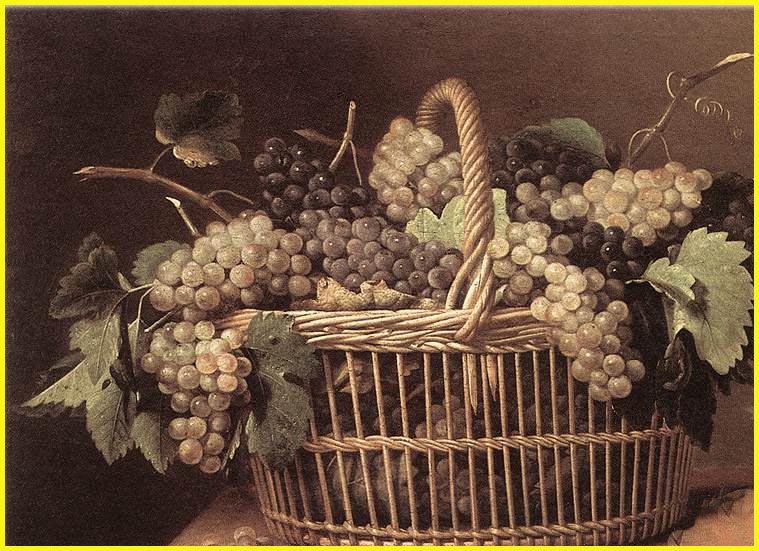
It has four proper seasons, long and fantastic sunset, delicious fruits, beautiful pine and cedar trees, more than hundred kinds of grapes, and many other worth mentioning things. These several kinds of grapes all exist, and each one has its own name. Herati grapes are the world’s most famous and delicious grapes. It is as sweet and fine as if it doesn’t have skin. But the wonderful thing for the city is that there is an old story of discovery of wine there for the first time. The story of discovery of grapes and wine in Heart, is mentioned in a famous book - Nawrooznaama- that means ( the book on Equilibrium Day) written by great and famous scholar and poet of 12th century, Omar Khayyam. This story is also turned into poetry by Asef Fekrat. Here, you read a translation of that story that originally is written in Persian.


Wine a Heavenly Gift for Herat

In the heart of Asia
Is located an ancient city now called Herat
Its ancient names were Aria, Hari, and Herai
Once there was a king
Who lived in the citadel called Shamiran-dezh
It means the castle of Shamiran
Therefore, the king entitled Shamiran shah
Famous, brave, just and kind
Loved his subjects and they loved him
In his time, Herat was populous and the people were well-to-do
One day, around the Equinox that they call Nawrooz
The king, the royal family, and courtiers were in country side
Entertaining, hunting, and sightseeing
Suddenly, over their heads, in the deep sky, appeared an eagle
Coiled by a fearful serpent, looked miserable and helpless
Flapping its wings, as if it entreated for help
Shamiran shah addressed his courtiers:
“Who is who wants to save the eagle from this terrible serpent?”
His son, Prince Badhan, stood in front of his father; kissed the earth,
The king gave a hint that meant permission
The Prince kneeled, took the bow, pulled the arrow, targeted the serpent
Without harming the bird, the serpent fell far away, nailed into the earth by the arrow
The eagle, released, enjoyed its freedom and turned around the crowd, several times
One would say it was appreciating the Prince and thanking the king
Finally, the bird disappeared
That year passed well and another spring came
The countryside became green and trees flourished with blossoms
At the same time they were sitting at the same place
Perhaps, the story of the eagle and the serpent had been forgotten
Suddenly, the eagle reappeared
Free, and flapping its wings energetically and joyfully
Turned around, above their heads, several times
Fled down before the court of the king
Threw something from its beak on the earth
Then fled up, turned around the sky several times and disappeared
The king bade the servants to see what the bird had thrown
There were some seed or grain-like things, never seen before
Chief Gardener was summoned to examine what the seeds were
He kissed the earth in front of the king and said:
“God saves the king!
Since we can remember, nobody has seen nor mentioned such a thing
However, let us sow them and wait if they sprout and grow”.
***
They sew the seeds that sprang after some days
The little plant was quite different from the beginning
Fine and winding branches, beautiful well-shaped leaves
The plants grew and brought up clusters of fruit
When the fruit ripened, one would have said they were shining jewels
***
When the fruit looked quite ripened
Chief Gardener picked some clusters
Put them in golden plates and brought them to the king
The king was excited but said:
“Nobody should eat the fruit without experiment
Lest it be a poison “
Put the fruit in hives and take its juice
They put them into hives, and closed the doors
After some times the gardener saw that the hives were boiling
He came to inform the king
Kissed the earth and said:
“God saves our king, the juice in hive is boiling
Without heat and fire”
The physicians of the court said:
Let it boil now, and bring it when it ceased boiling
***
When the juice was ready
Chief Gardener poured some into crystal jars
Brought them to the court, and placed them in front of the king
The king summoned the ministers, physicians and wisemen
Told them to think what they should do
At last, they gave their advice to which the king agreed:
“At prison, there are many guilty people
Convicted to sentence, and waiting for execution
Give them some of this mysterious juice
If they died, they would have been punished
If they survived, let them be free as rewarded
***
They brought a prisoner who was to be executed the next day
Bade him to sit and gave him a cup of the juice
He avoided screaming: “No poison,
Kill me by a sword or hang me!”
However, soldiers forced him to drink
He frowned when he drank and said:
“I never had tasted such a bitter thing.”
But after a while, he rose his head and said:
“May I have another cup?”
They give him other cup and he wanted more
After a third cup and he wanted fourth
They gave him as much as he asked
The more he drank the more he liked to drink
His face became ablaze and his eyes turned red
He laughed, he screamed, he wept, he cried
He said different things he never would have said before
Eventually, he fell in a deep heavy sleep
He remained asleep for three days and three nights
When he got up he said: “Where is that miraculous water?
Please give me some more.”
The king released him as a thanksgiving
****
Then the king summoned all wisemen and all physicians
To decide and test the mysterious drink
They agreed that it was a gift from God and had come from the heaven
But no one should exceed drinking
If one drinks orderly and in a proper way
It will be like the water of life and antidote
But if one exceeds in drinking it will be worse than a poison
They celebrated the event all around country
Then the king ordered to distribute the seeds all over the country
After some time there grew numerous grape gardens and orchards
They called the plant “tak” and “raz”
They called the grapes “angoor”
They called the wine “ mai”
Khayyaam, the great Persian poet and scholar says:
If you drink wine, drink with wise people
Or drink with a beautiful smiley tulip-face sweetheart
Don’t drink too much, don’t be addicted, don’t drink in public
Drink sometimes, drink a little, and drink in private.


Resources:
Darmesteter. Zand Avesta -------> Uraniski. Iranian Etymology. Tehran. ?
Khayyam, Omar. Nawrooznaama (Persian). Editor: Mojtaba Minowi. Tehran. 1321 (Persian calendar).
Saifi Herawi. ( The History of Herat ) (Persian). Editor: Zobair Seddiqi. Culcutta – India. 1943
http://www.globalgourmet.com/food/wineday/2000/wd0900/wd090500.html

Thursday, November 24, 2005

Lost One

I heard that a Kurd lost his camel in a desert
He searched for the camel but did not find
He could do nothing but to sleep by the way
Sad and grieved for the camel
The day went and the night came
The moon enlightened the desert
The Kurd awoke, heart full of sorrow
But he saw the camel standing under the moonlight
He looked at the moon and said:
How can I praise you?
You are good, nice, beautiful and bright

O Lord! Kindle a light in this desert
So the human wisdom may find its lost one..!
From an ode by Rumi, translated by Asef Fekrat